


Understanding DPSH Testing: A Practical Guide to Soil Strength Evaluation
Dynamic Probing Super Heavy (DPSH) testing is a widely used geotechnical investigation method that provides quick and cost-effective insight into soil strength and consistency. Unlike more elaborate testing methods, DPSH is relatively easy to deploy and is often used for profiling subsoil conditions, especially where borehole drilling is either not required or too expensive.
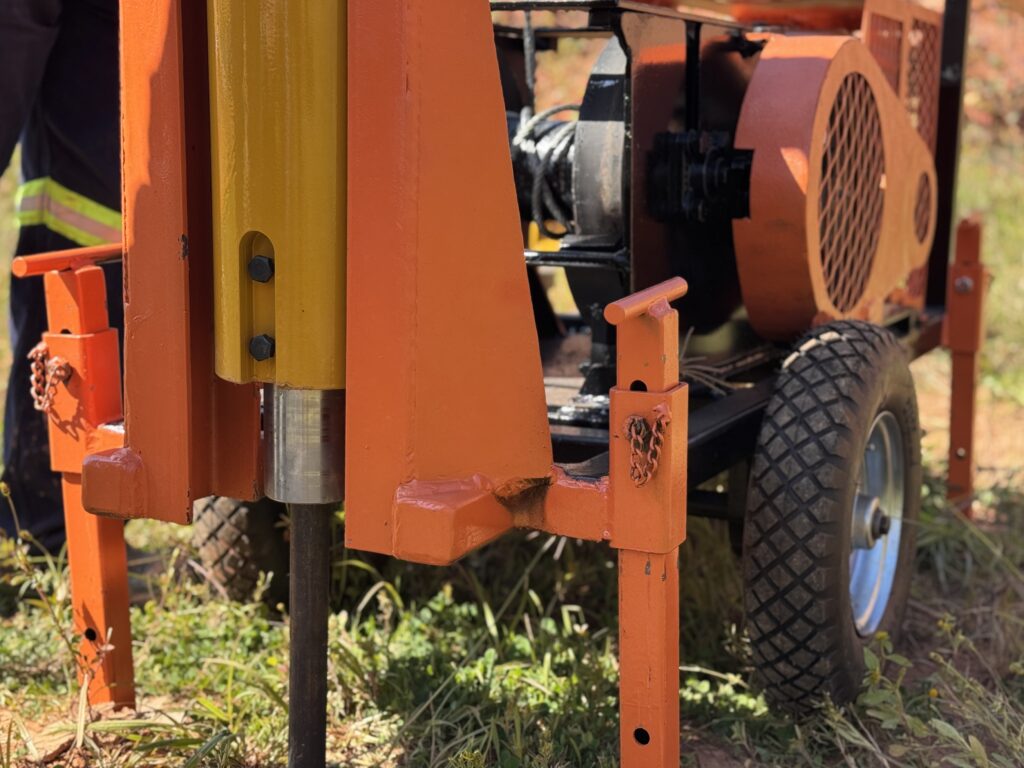
What is DPSH Testing?
DPSH involves driving a cone-tipped rod into the ground using a standardized hammer weight (typically 63.5 kg) dropped from a fixed height (usually 750 mm). The number of blows required to drive the cone 100 mm is recorded, and the total number of blows for each 1-meter penetration is used to assess soil resistance.
This test is particularly effective in identifying:
- Changes in soil layers
- Relative soil density
- Zones of weak bearing capacity
- Depth to hard stratum or refusal
DPSH-A and DPSH-B are the most common variants, with the difference lying in the dimensions of the cone and rod, as well as energy transfer efficiency
.
| Feature | DPSH | SPT |
|---|---|---|
| Purpose | Soil profiling, compaction checks | Soil strength for design purposes |
| Equipment | Handheld or rig-mounted | Requires borehole and rig |
| Blow Count Output | Blows per 100 mm or per meter | Blows for 3 × 150 mm increments |
| Sample Recovery | No sample | Disturbed sample collected |
| Test Depth | Up to 15-20 m (depends on soil) | Can go deeper with boreholes |
| Mobility | Highly portable | Requires more setup time |
| Cost | Low | Moderate to high |
| Use Case | Profiling, compaction testing | Foundation design, site class. |
While SPT remains the benchmark for engineering design due to its ability to retrieve samples and deliver N-values, DPSH is more practical in early-stage investigations and compaction control.
| Feature | DPSH | Hand DCP |
|---|---|---|
| Hammer Weight | 63.5 kg | ~8 kg |
| Application Depth | Up to 20 m | Up to 2-3 m |
| Use Case | Deeper soil profiling | Pavement subgrade evaluation |
| Accuracy | Better for deep profiling | Better for near-surface soils |
| Ease of Use | Requires rig or driver platform | Completely manual |
Hand DCP is best for shallow investigations and road layer quality control. DPSH, in contrast, provides deeper insights into soil behavior, especially in large-scale or remote projects.
When to Use DPSH Testing?
DPSH is ideal for:
- Site classification prior to large-scale drilling
- Rapid identification of soft spots and fill material
- Comparing relative densities across a site
- Foundation depth estimation in residential and industrial developments
- Road, rail, or airport embankment studies
Final Thoughts
DPSH bridges the gap between lightweight DCP tests and more detailed, invasive SPT tests. While it doesn’t replace the precision of borehole-based testing, it plays a vital role in saving time and cost during preliminary site assessments.
If you’re managing construction in areas with variable soil profiles—or if you need a quick, affordable testing method—DPSH could be your go-to tool.
Need geotechnical drilling or site classification testing done in Gauteng or beyond? Contact us today to find out how our DPSH and rotary core drilling services can help you make confident foundation decisions.
